
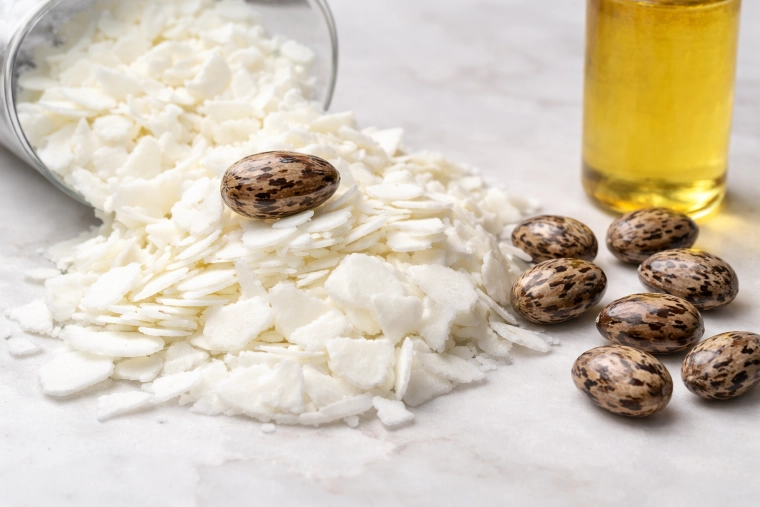
Hydrogenated Castor Oil is created when pure castor oil undergoes hydrogenation. It’s a chemical process where hydrogen atoms bond with the oil's molecular structure under controlled heat, pressure, and catalytic conditions.
This process changes the oil from a viscous liquid into a firm, wax-like solid substance. HCO (Hydrogenated Castor Oil) has a versatile nature. It can be used in cosmetics, medicines, lubricants, plastics, and paints for different purposes.
Main Properties of Hydrogenated Castor Oil:
- Solid wax form
- Melts at 85-90°C
- Repels water
- Non-greasy texture
- Chemically stable
- Biodegradable
Why Call It Castor Wax?
Hydrogenation changes castor oil into a wax-like solid material. It looks and behaves much like regular wax. Because its texture, melting point, and use are similar to traditional waxes, many industry professionals simply call it “castor wax” for easy reference when working with this ingredient.
Features That Make HCO Multi-Use
- Strong Thermal Resistance: This substance stays solid up to 85-90°C. It doesn't melt during storage, shipping, or in hot weather.
- Improved Formula Compatibility: HCO helps oil and water ingredients mix together when they normally wouldn't.
- Water Resistance: Products with Hydrogenated Castor Oil resist moisture. They last longer in humid conditions.
- Stable Under Processing Conditions: It doesn't break down or spoil easily. No synthetic preservatives are added whereas extending product's shelf life.
- Eco-Safe and Biodegradable Properties: It is obtained from plants, so it is safe for people and the environment with natural breakdown.
Role of Hydrogenated Castor Oil in Solubilization
Hydrogenated Castor Oil works as a binding agent between oil-based and water-based ingredients. This property helps different ingredients mix properly, even when they normally don’t blend well.
When oil-based elements need to combine with water-based ones, HCO helps hold them together. This prevents separation and keeps the formula uniform throughout the product’s life.
Benefits in Emulsions
- Creates stable oil-water mixtures
- Reduces the need for multiple emulsifiers
- Improves product texture
- Prevents ingredient separation
- Works at low usage levels
Use of Hydrogenated Castor Oil in Different Industries
- Personal Care & Beauty Products: It is added to lipsticks to provide structure. Face creams gain stability from HCO, whereas body lotions benefit from better softness and moisture.
- Pharmaceuticals: It protects active ingredients with an enteric coating. This helps tablets stay firm as a binder. Also, it controls the release of medicine over time.
- Lubricants & Greases: It performs well in high-temperature lubricants, forms protective films during metal processing, and thickens special greases.
- Plastics, Rubber & Polymers: It reduces friction in polymer manufacturing and helps products come out of molds easily. It also makes materials more flexible.
- Paints, Coatings & Inks: Coating specialists use it to add shine, make films harder, and improve moisture resistance. It also helps pigments disperse evenly in decorative and industrial coatings.
Top Advantages of HCO in Manufacturing
- Multi-Functional Ingredient: No need to use separate ingredients for different functions. A single HCO ingredient can handle texture improvement and stability support.
- Economical: Uses smaller quantities than synthetic alternatives, lowering costs without reducing product performance.
- Environment-Friendly: Made from renewable crops and naturally biodegradable, it supports sustainable and eco-friendly manufacturing.
- Formulation-Friendly and Versatile: HCO works in water-based, oil-based, and solvent-based systems without compatibility issues in production or storage.
Technical Specifications
- Melting Point: 85-90°C for standard grades
- Hydroxyl Value: Provides emulsifying properties
- Acid Value: Low values prevent unwanted reactions
- Iodine Value: Low after hydrogenation, confirms stability
Modi Oil Mill – Trusted Supplier of Hydrogenated Castor Oil
- Best Quality: Every batch from Modi Oil Mill maintains the same melting point and specifications for predictable production.
- Custom Grades Available: Modi Oil Mill creates custom HCO grades with specific melting points and properties for your needs.
- Bulk and Export Supply: We supply from 100 kg to multiple tons, shipping across India and internationally with proper documentation.
Why Manufacturing Businesses Rely on Modi Oil Mill?
- Technical expertise that helps optimize every formulation.
- Order flexibility that adapts to your manufacturing needs.
- Pricing advantages that support smarter cost management.
- Supply reliability that protects your production timelines.
Conclusion
Hydrogenated Castor Oil solves formulation challenges across industries with its unique properties. It thickens, stabilizes, emulsifies, and resists heat—all while being natural and biodegradable. Modi Oil Mill supplies the best quality Hydrogenated Castor Oil with defined quality parameters and dependable delivery. Our technical team supports your formulation development. Need HCO for your manufacturing? Contact Modi Oil Mill for samples, specifications, and bulk pricing.
Partner with us for quality Hydrogenated Castor Oil—reliable supply and technical support for your success.
FAQ
HCO is used in cosmetics, pharmaceuticals, lubricants, plastics, and paints as a thickener, stabilizer, binder, and emulsifier.
Yes, Hydrogenated Castor Oil is non-toxic and approved by FDA and EU for various applications including food-contact uses.
Castor oil is liquid, while Hydrogenated Castor Oil is solid wax. HCO melts at 85-90°C and is more stable.
Yes, HCO comes from renewable plants and biodegrades naturally without toxic residues.
Yes, Modi Oil Mill produces custom grades with specific melting points and properties for different applications.
